Desert Fathers
What Deep Springs gave me

i. Failed Poems and Men
I recently received a thank-you note from Shawn’s children.1 I had met the three of them once, eight years ago, at their father’s memorial service. I hadn’t seen him for almost twenty years before that, but I didn’t hesitate to call him a friend then or now. A number of us had been asked to contribute to an investment fund for those kids, then quite young, which would be given to them when they were going to college. I made a modest contribution with the resolve to do more over time, then let it slip from my mind. The note came as a touching embarrassment after all these years when I should have been doing more.
Just the day before I’d been cleaning up one of the neglected corners of my house and had come across the sheaf of student poems from the class Shawn and I both took in the autumn of 1997 and which converted me from my disdain for poetry. The sessions alternated between a study of one modern poet and a workshop of our own compositions. I couldn’t get through re-reading most of my own work, but I remembered some of the others, particularly Shawn’s. I didn’t really like his poems at the time; he was very Richard Brautigan and Charles Bukowski while I was groping my way to the style of a dime-store Eliot. But his poems were strong in a way most of ours, and certainly mine, weren’t. “This is a failed poem,” one of them began, “and Jesus was a failed man.” God how I hated that, unbeliever though I was. It felt juvenile, something to épater la bourgeoisie, but it stayed with me ever after, until and beyond my discovery that describing Jesus as a failure is its own kind of fealty to doctrine. And it was perfectly sincere. It was about a friend who had died; whether by suicide or not, I can’t now recall.
Shawn had the soul of poet, with all the good and the bad implied by the phrase. At our end-of-term parties, when most of us sorted ourselves into drunks or nurses, he was a rare hybrid. He had already built up a tolerance that I didn’t yet know to associate with problematic drinking, and a tendency to caregiving that I didn’t yet know to associate with the wound of unmet needs. His insight tended more than most to direct and rough-hewn phrasing (subscribers at the Antelope Springs tier can get the uncensored story of his feedback to my poetic homage to Pound’s “Love and Idleness”). He was responsible in the way that you can find annoying, even as you know that as a community you depend on it. He was a little more advanced toward adulthood than most of us, in good ways and bad. I never had any conflict with him, and while we were not particularly simpatico, I really did love him through the gentle strain our personalities imposed. Of the fourteen who graduated together, he got married first of all of us, had children first, and was the second to die.
I decided to send his poems to his former wife, the mother of his children. Would she, or they, ever want to see them? Would any of it mean anything to them? I don’t know, but it’s not for me to guess. You only get so many pictures of your father at 18, pouring his heart out in perhaps the strangest, smallest, most eager venue he’d ever have for it. And it means something to me, who knew him for a small slice of his abbreviated life but who remembered things that only a handful of people could. I supposed I’d want my children to have my juvenilia if I were gone too soon. Failed poem, failed man: the theme, once heard, becomes hard to ignore.
One line from my own poems did stand out to me. I compared the mountains around Deep Springs Valley to “melting fingers of a luckless Titan fleeing Vegas.” The first and last failure is always the failure to escape.
ii. For what came ye into the desert?
My alma mater, Deep Springs College, has had a moment in the media sun. This reflects the school’s success in deliberately placing student-authored stories into various publications, intersecting with a broader vogue for crisis and aimlessness in the world of higher education. 60 Minutes was there a few years ago. The New York Times ran a big piece on it this summer, which some half dozen friends and family sent to me. A French magazine got in on it. Maybe, writers suggest, Deep Springs proposes an alternative model in the age of A.I. and campus culture wars. When I arrived, there had been only two articles anyone knew about. Visits from journalists were scarce and the magazine pieces in the years that followed were, in our alumni circles, big events (we mostly disliked Dana Goodyear’s New Yorker story while a photo-heavy Vanity Fair puff piece got more mixed reviews). When I was there, American higher education was still in its pomp, though as ever it was wreathed in the journalistic incense of ideological conflict and cultural foreboding. Deep Springs was offered, then as now, as a breath of fresh air.
But the setting and the visuals were always part of the angle. While I don’t remember any print reporters coming around, we did spend a few days under the supervision of CBS Sunday Morning. “A place…with room enough…to think,” Terry Bowen intoned over a shot of one of my friends riding a horse against the stirring backdrop of those Titan-corpse mountains (I’m there in some b-roll). And much more unexpectedly, a French filmmaker asked to come out to make a documentary. “Deep Springs represents regenerate blood,” his letter to us said. We knew this was flattery and a bit much but were helpless against it nonetheless. And while the documentary was never finished, this filmmaker and a colleague made a couple of lengthy visits during my second year, becoming weirdly treasured members of the community. In hindsight it was a terrible idea, but someone got hold of the raw footage and we watched hours of it after Shawn’s memorial service.
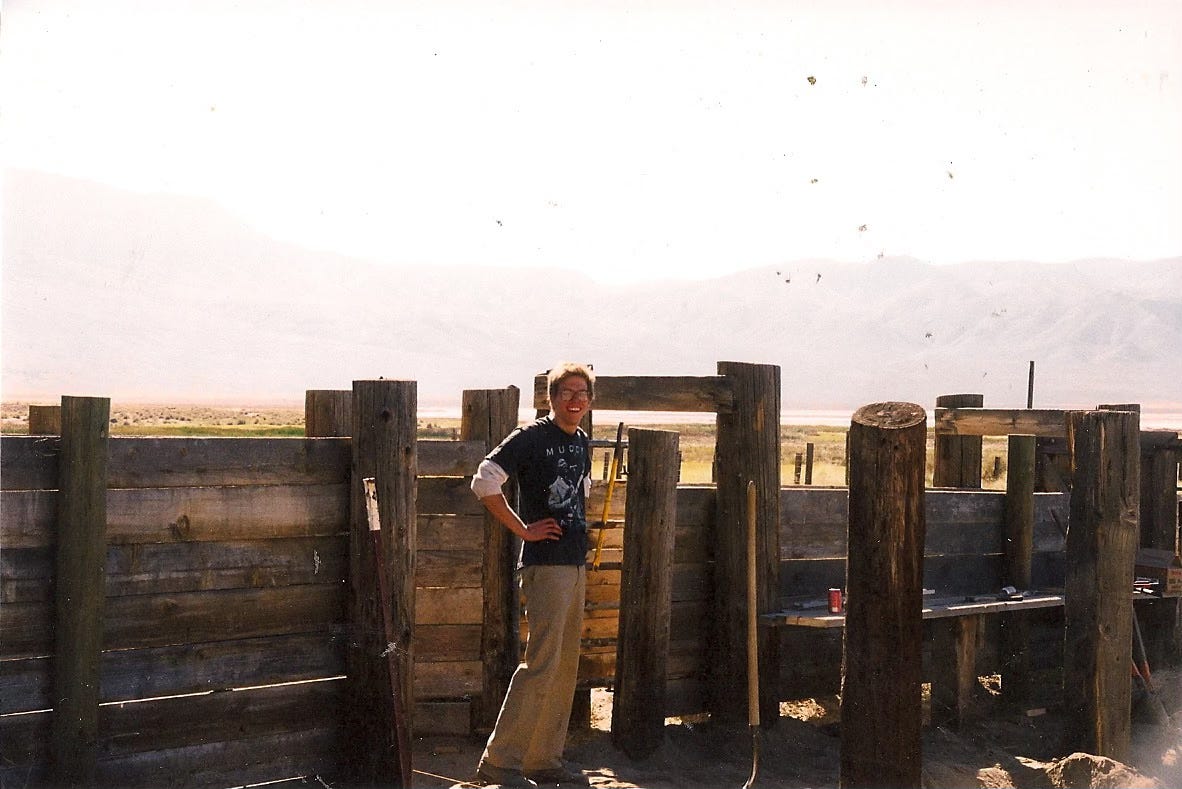
I graduated, with Shawn, in 1999 in a ceremony marked with bespoke diplomas printed with fake degrees and dissertation names (“City of Olive Oil: Cuisine and Decadence in Augustine and Robert Johnson” was the dissertation for my “Doctor of Blues” degree) and the ceremonial burning of a treasured item on a raft floating on the large lower reservoir. It took me twenty-five years to write about the place for publication. I presented Deep Springs not as a model for any other institution but as an example of the fragility and importance of any institution’s founding ethos. Be it however weird or embarrassing, you lose it at your peril.
But even here, even after all these years, I was playing the Eliot game, hiding my subjective experience in a host of observed details and synthetic conclusions. I still haven’t found it within myself to describe the stabs of loneliness after my long-distance relationship ended and I felt myself without an anchor outside of our valley. I left out the poison that blossomed into the community during my second year, when we tried not to rehire a faculty member, when another faculty member started behaving toward a student in a way that the student, it seemed to me reasonably, saw as sexual harassment, or when the marriage of a third faculty member started falling apart. When I think of them now, all the heat is gone out of my memories. Their failings were so obviously ordinary and their tragedies so obviously their own, while we were stuffing them into costumes and pushing them out onto the boards for the grand opera of our youth.
And that wasn’t the worst of it. A recent graduate, a guy I really loved then and now, flipped a vehicle driving away from the valley and could have died. I crashed our Farmall tractor into the concrete irrigation ditch after waiting too long to make a turn, slamming my sternum into the big steering wheel and knocking off the front tire before the shuddering frame came to rest, thankfully, upright. It was a dangerous, humiliating blunder that I have ever after turned into a colorful story. And two months after I left, while working at a restaurant with a fellow alumnus, I got a call from my mother telling me that a student had died in a tractor accident. We’d shared the place for that tense, abrading year. He was sweet and sulky, earnest and unbending, and probably the first person I ever heard use the term “ecofeminism.” With him as with Shawn I felt the warp of our difference pressing against the woof of our shared world, but when we made music, when we played “Chameleon” together at the spring recital, we were the best of friends. Eight years later, I ended up living not a half mile from his grave. I used to visit it on Easter. To the school’s credit, there were serious improvements in safety made after this tragedy. All the same, when every profile, even the most fawning, has someone, student or faculty, saying that Deep Springs is “not for everyone,” that does not begin to describe it. It really is possible to give 19-year-olds too much responsibility.
It’s precisely at the point of subjective experience that the more grandiose and picturesque claims made on behalf of the school fall apart. The most hostile journalists and op-ed writers, let alone the mind-numbing Times commenters, tend to miss the mark when criticizing the college. If you want a proper skewering of the place, you just need to hear from its students.
One piece by a recent alumnus made the rounds on Substack, having won a prize from The New Critic. At first I nodded and winced along, but it seemed eventually to run toward uncharitable harshness. It’s a good, sometimes remarkable piece of work:

It’s true that the experience doesn’t square with the omnipresent images or the utopian aspirations, but then again, how much time do students at small liberal arts colleges spend walking with faculty through the leafy, sun-dappled quads of the brochures? All the same, I recognize the stance. One torment of a verbose and well-read youth, all the more excruciating for being invisible until far too late, is believing oneself to know the score, to have seen behind the curtains of illusion that muffle the world. This bit, however, rang as true to me as anything I’ve read about the place:
In conclusion, I would like to suggest that the much-touted problems with modern education are not really with education but with the current of our lives, and that to abandon “normal” college for “alternative” models like Deep Springs is only to dam the river and flood everything else. I do not know if this problem is old or new. But the impossibility of escape is precisely what frustrates Deep Springers and compels them to tell reporters, in interview after interview, that what is valuable about the college is, in the words of one current student, that “there is no place to hide,” and to say it with all the force and bewilderment of someone who has tried their very best to do so.
That there is no place to hide did not, in my experience, preclude ways to hide in plain sight. We didn’t know what to do with or for the guys (we were all guys then) who took to the bottle, faded into depressive silence, or buried themselves in their rooms. But we all saw it happen, and I’m sure I wasn’t alone in imagining myself a step or two away from breaking down or going out to the end of the ranch road and thumbing a ride out. Yet I would have said then, and still would now, that there’s something to be said for damming the channel, for a time, and seeing what the flood does to the landscape. The metaphor is perhaps too good. What else is education but a selective constriction of life’s stream for the purpose of deepening, broadening, harnessing, revealing, reshaping? The double movement of escape many of us were attempting—from the world of what we called “real college” first, and then from Deep Springs itself—was not a malfunction. The illusion of escape has to die somewhere, sometime.
For me, at least, I can’t separate any aspect of my life today from what I did there. I doubt you could find a “treatment effect” for the model, and I didn’t notice it changing anyone’s personality in any fundamental way. A long-time faculty member and leader seemed to think that most of the students (of my era, at least) were neurotic maladjusted losers. I consider this aversion now with the chill of retrospect, but I still don’t think was right. It doesn’t make heroes or saints any more than it makes carpenters or dairy farmers. But it’s where I grew up, for better and for worse. I struggle to imagine a course, a script, for my own children to enter adulthood that doesn’t involve two years of hammering uselessly at farm fields and washing dishes for fifty people. The failed child, to borrow a phrase from a poet I couldn’t stand before Deep Springs, is the father of the failed man.
What Deep Springs gave me—and I don’t mean this melodramatically, I was often quite happy there—was the gift of despair. I didn’t know to call it that until the later course of my education, quite unthinkable before Deep Springs, introduced me to Kierkegaard. But that’s what it was. The conviction that drove many of us to come, that if only one were somewhere else, somewhere more real, more richly communal, more tied to honest labor, one might live an authentic life—that is a form of despair. Then the realization that all of those things do not, in fact, confer authenticity, that a part of oneself is always estranged by reflection and the disproportions of the self and the place—that’s despair, too. But there, in the disappointment of the aspirations in which despair hides itself, is where you can really begin. Failure, of the deepest, bone-dry, type, the failure of self, failure of community, failure of ideals, failure of charity, failure to turn the Farmall in time, is the door to whatever freedom you’re ever going to experience in this life. “Gentlemen, for what came ye into the desert?” the founder of Deep Springs exhorted his first group of young charges. His improving, idealistic answer, about preparing for a life of service, only began to be true after I’d seen it disproved a hundred times. Just like love only becomes conscious of itself after being demolished to the ground by conflict, resentment, tedium, and the subtle disgust that comes from too much time arguing over poems and student body motions.
iii. The whole damn place goes crazy twice, it’s once for the Devil and it’s once for Christ
Once or twice I tried my hand at nursing during the end-of-term bacchanals that exploded from the end of the student body meeting marking seven weeks of observing the “ground rules” against alcohol, drugs, and leaving the valley.2 I’d leave a can of something non-alcoholic next to someone who was power-napping after a lot of tequila, or check on the casualties splayed on the main circle. But most of the time I overcame the impulse and surrendered to the combustion, which was unlike anything I ever knew before or after. There was a darkness in the heart of the flame, to be sure, a carnivalesque death’s head leering at us as we expended the latent energy from work, study, and trying to run things together. One might pass out from too many aggressive draws on the hookah, or crouch on the floor of the kitchen to huff the dissipating smoke from a busted joint. When many of us were back in the valley for the college’s 100th anniversary, peeking into middle age with spouses and children in tow, it suddenly happened again. A relaxed gathering around our tents in one of the alfalfa fields suddenly tipped into something else, and before we knew it, the long-recovering smokers were hitting up current students for any cigarettes they might have stashed about. Having that conversation with people on the front porch of the dorm we were the first to inhabit, through a miasma of two decades and too many beers, was not a high point in my relationship with the school or with myself.
But sometimes it was beautiful. The night of our graduation, the explosion drove us upward to the reservoir, where we swam together one more time in the musk of sagebrush and under the moon and stars and where two years of highs, lows, and grueling middles seemed, for the moment, to have dissolved from our skin. Too bad we’d have to walk down, I said. “It would be better if we could just float,” a friend replied. As if the basin of irrigation water might somehow overflow and merge with the Milky Way above and the distressed currents of our various lives. Yes, that would be nice.
There are no pictures or video from that night, at least that I know of, but I am returned to it every time I hear “Closing Time” by Leonard Cohen. “The moon is swimming naked and the summer night is fragrant with a mighty expectation of relief” is exactly what it felt like. The whole song echoes the experience as seen from its end. But the moment that lashes the song to my heart is his return to the mysterious figure he mentions in the first verse. “My very close companion gets me fumbling, gets me laughing / She’s a hundred but she’s wearing something tight.” That was the place for me: too old to know, too protean to get my hands around, but all the more seductive for that. She’s a poor Diotima offering her wisdom on love in misdirection and riddles. She’s the smoldering coal ship in Conrad’s “Youth,” nursed along age to age by reckless boys for the sheer stubborn hell of it. Is that different from any education worthy of the name? I don’t know. Should it be? I can’t say, and anyway I have committed myself in advance to not moralizing here. Maybe it would be better if it were properly monastic, or seriously vocational, or if it ditched the cowboy mythos and focused on something less romantic.3 Or it could be abandoned to the sand like the ghost towns around it. But that’s just the voice of despair again. It would be trite to say that I wouldn’t trade the experience for anything, but perhaps closer to the bone to say that I don’t know what medium any trade could be denominated in.4 If that’s too obvious, well, life is about learning the obvious. “And I lift my glass to the awful truth / which you can’t reveal to the ears of youth / except to say that it isn’t worth a dime.” God help me but I loved it, just like I loved Shawn and the guy who flipped the car and the guys I accidentally burned down the sauna with and the guys I argued with all night long. All the ragged would-be escapees in our ironic exile, busted in the blinding lights of closing time.
Not his real name.
These rules were never, in my time, quite strictly observed, but infractions tended to be discreet and to be confined to a relatively small part of the student body at any given time.
Two of the guys I was there with started educational communities that borrowed aspects of the program without the John Ford visuals. Both of them, Outer Coast and Thoreau College, are worth a look and a few spare dollars if you have them.
It could much more fairly and meaningfully be asked whether the college made a good bet by admitting me. That a school may disappoint a student is obvious, but that we might prove unworthy of a school’s trust, regard, or full-tuition scholarship is a much harder question to formulate today. Perhaps a question for another time. Is it possible that some Deep Springs alumni displace a feeling of not having lived up to their own promise onto the school’s supposedly false and toxic culture?
Rounding the corner towards 60, White Sox fandom, Deep Springs and becoming a father seem to explain everything about me except my diet.
beautiful.