Dancing at the Gallows
Rhine Valley Diarist

I previously wrote dispatches from Rome, Naples, Munich, Vienna, and Berlin. For more on Pieter Bruegel the Elder and the background of this project, see Six Chapters on Becoming Insatiable, Blood in the Snow, and Obsessions in Review: Brueghel. The travel depicted here was generously supported by the congregation I serve, Christ Lutheran Church in Dallas, Texas.
“Like colored bubbles, empires rose up from that country, rose up and as soon burst again,” writes Anna Seghers of the region where the Rhine and Main rivers meet in 1942’s The Seventh Cross. “They left behind no limes, no triumphal arches, no military highways; only a few fragments of their women’s golden anklets. But they were as hardy and imperishable as dreams.” The Franks followed, then a monk-evangelist1, the Holy Roman Empire with its electors, the wine-makers, the crusaders who burned the city’s Jews (“four hundred of them at one time in the square of Mainz which to this day is called the Brand”), the Jacobins, the Grand Army of Napoleon crossing on floating bridges, the abortive revolutions of 1833 and 1848 (“two little threads of congealed blood”), and the Second German Empire. “Was it really the Battle of Verdun the schoolboys heard as they lay on the ground beyond Zahlbach, or was it merely the continuous trembling of the earth caused by railroad trains or the marching of armies?” Then the flags of the allied occupation authority flew over the rivers, replaced “hardly ten years ago” with the old German tricolor. Bands played and fireworks were launched to mark the return of German sovereignty.
One sees these deep-history montages in the literature of Seghers’ generation. A bravura passage in Brideshead Revisited echoes it. Patrick Leigh Fermor’s delightful A Time of Gifts comes back again and again to the wanderings of tribes and peoples though the many landscapes he traverses on foot, and the states and dynasties that claimed them at different times. But Seghers’ version stays with me because it is not about the past.
Now, she writes, “thousands of little swastikas twistedly reflected in the water” which over the ages had lapped against countless field standards and flags. Seghers, a Jewish Communist, grew up in Mainz. Her father was the curator of the art in the Mainz Cathedral, where her protagonist briefly hides out. She fled Germany in 1933 and set her novel shortly after. Seven men escape from a concentration camp. Six are captured and killed, their bodies fixed to crosses as a warning to the others. The bulk of the novel concerns the seventh escapee, his hiding and running through the cities and countryside of the rivers, his hope to flee Germany by the Rhine, and the cross awaiting him at the camp. “We have now arrived,” Seghers says as her flash tour of the region’s flags and armies ends. “What happens now is happening to us.”
None of that history was immediately visible to me when I arrived in Darmstadt, a short trip south of Frankfurt and east of Mainz. In the early stages of planning my journey, I had thought to skip it altogether. It is not convenient to any other place I was going, and it is home to only one painting by Pieter Bruegel the Elder. But as I studied, I learned that the painting, which had not particularly captivated me in reproductions, was a late work which the artist left to his wife in his will. It clearly had an importance in the context of his career that could not be overlooked. Thanks to the family of some Dallas connections, I would have a comfortable and friendly lodging for the night. And it would bring me at last through that region whose name is virtually synonymous with the contests of European history.
My hosts met me in the train station car park and took me to their home to deposit my bags and offer me a “snack.” This term has a different meaning, I suspect, for Germans, because it included three kinds of sausage and as many breads, mandarin oranges, cheeses, cookies, and small rhombuses of quince jelly. They had lived and worked in the U.S., but even before that, the wife told me that she grew up listening to the radio from the American military installation in Frankfurt and was scolded by her English teacher for speaking in Americanisms.
Reluctant though I was to leave any uneaten jellies or sausages, the afternoon was wearing on and I was discovering a new mania for laying eyes on my quarry as soon as I could, as one might seek out a flight’s departure gate before finding something to eat. The husband stayed home to cook dinner while the wife and I tramped out in the ice and snow to go to the Hessisches Landesmuseum. She was an art lover, the kind of parent who bought Pieter Bruegel the Elder jigsaw puzzles for her children when they were young. A kindred spirit. I didn’t have a local transit pass and the tram station didn’t have a ticket kiosk, so my hostess opted for the bus, where a fare could be purchased on board (in any other country I might have expected to mooch an inbound tram ride and then buy a round-trip ticket at my destination, but as with snacks, I respected German customs).
The museum itself is a marvel, a 19th-century attempt at universality shipwrecked in an age of minor ambitions. You can see a chromatically-arranged collection of snails, medieval armor, a Woolly Mammoth skeleton, an astronomical clock, and classic Renaissance paintings under one roof, with an extra fee for the exhibit on the science of clouds. I couldn’t resist perusing a few of the galleries of plates and plants as we went, and finding the passageway to the picture gallery took some doing.


But eventually we got there and worked our way through the church art to the 16th century and The Magpie on the Gallows.
To sweep past it at a brisk museum stride, you might not notice much beyond a classic Northern Renaissance landscape. But if you stop, the oddities start jumping out. There’s a gallows in the center of the image, for one, mounted on what appears to be a rock outcropping. To the right is a cross with a shrine-like candle mounted in its center, and beyond that, a mill on a stream. On the other side of the gallows, three people are dancing, and two more are observing. There are more figures in or near the woods on the margin of the scene, and as you follow the river valley into the distance you see a town and more people coming up toward the gallows. And there’s a color gradient around the central scene, green high summer to the right and brownish autumn to the left. Why is the gallows seemingly twisted like an MC Escher structure? What is the magpie doing on top of it?
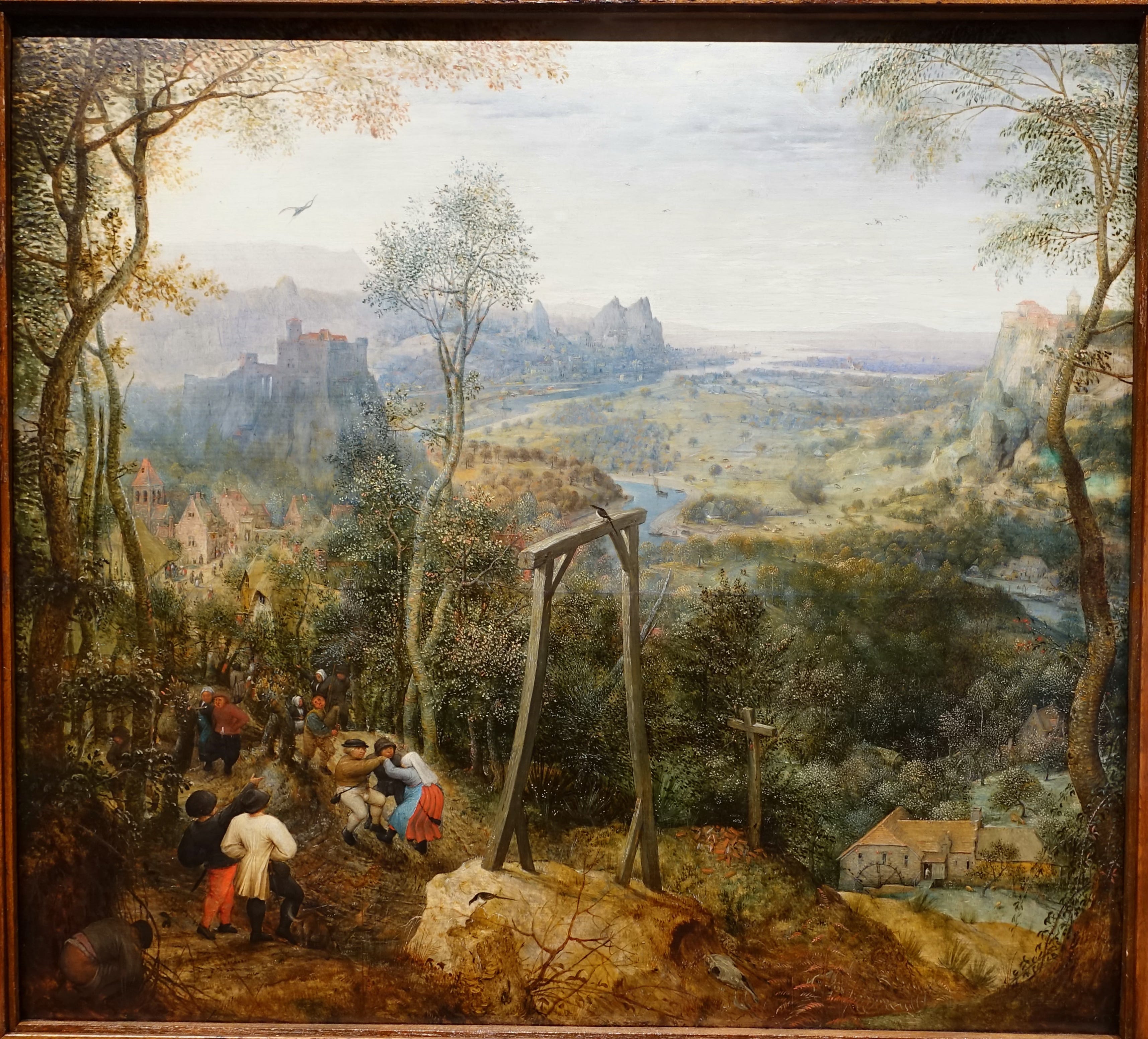
As with most of Bruegel’s paintings, the commentary is divided on the meaning. The magpie is a symbol of gossip, but is Bruegel making a generic point about how loose lips lead to official crackdowns, or is he wishing the gallows on people who he suspects might squeal about him? And the dancers: is their heedlessness of the gallows merely foolish, or is it a deliberate defiance of death by the forces of life? So with the man defecating in the lower right corner, another Netherlandish proverb (“he shits on the gallows”) moved from the edge of the great anthology painting to a place that is greater than a mere proverb. Are we to lament that his contempt for the instrument of cruel justice will implicitly lead to his own death, or to cheer at his crude act of resistance? Someone is running away into the trees—an informer or simply someone looking to avoid trouble? Is the cross at the foot of the gallows an ironic juxtaposition or just a conventional late-medieval person’s acceptance of capital punishment within a Christian society?


When Bruegel painted this scene, the Duke of Alba was invading the Habsburg-ruled Netherlands with his Spanish troops. Their campaign of pacification was harsh and fantastically deadly. Bruegel’s circles in Antwerp and Brussels were not openly rebellious in either politics or religion, but like intelligentsias everywhere they were under suspicion. Their conformity to church and state had an ironic, pro-forma air. Risky work was, of course, nothing new, but in the rolling boil of the 16th century, all the good work was risky. Given that the gift of this painting in the artist’s will came with instructions for destroying certain other drawings and drafts he had made, I suspect the subversive readings may be closer to the mark. But there is no single answer with Bruegel. I suspect there is code here, but even the best cryptography could only reveal the deeper cipher of human motivation, distance, fear, and joy.
We stayed in front of it for a long time, taking in all the details. Then we explored the rest of the gallery. The province of Hesse was, I was told, a center of Jugendstil, so there was an interesting collection of turn of the century paintings and a few more modern. But we kept drifting back, a second time and then a third. I explained to my hostess that I always make three stops at the painting, if I can. For that third visit we stayed quite a long time in front of it (and there, unlike in Vienna and Berlin, you can get pretty close without triggering an alarm or getting a guard to reprimand you. My hostess was up in arms, not unreasonably, about Vice President Vance’s behavior on a recent European tour. She did not appreciate being lectured about the German parties’ rejection of a coalition with the AfD, the far-right anti-immigrant party aligned with Russia and the rest of the global far right. It’s like being told we should vote for Hitler, she said. Perhaps German liberals—in the older, European sense—are like German snacks: extremely serious about what they are for. It was hard to know what do so beyond shrugging apologetically. There’s no excuse for such reckless bullying by an American official, certainly not here in the place that served as a stage for so many of the 20th century’s nightmares. Not that everyone is afraid. Too many people are not. But the ones who are have every reason to know the stakes. There are always armies ready to sweep across the proverbial Rhine, in one direction or the other; neither our institutions nor our own minds are built to resist a sustained attack forever.
At last we made to leave, taking in the medieval room more slowly and deliberately than before. I had a beautiful dinner to look forward to, beef roulade with dumplings and some kind of angelic reduction, followed by conversation around the fire until midnight, a warm bed, and a train up the river that would pass through Bonn and stop briefly in sight of the glorious Cologne Cathedral. But yet I was reluctant to leave, and my hostess sensed it. “Do you want go back and look at it one more time?” she asked. I did.
And there, in front of a painting we had stared at and puzzled over, I saw something I had overlooked three times. Down from the menacing gallows and the vibrant dancers, just as the river is about to merge with Bruegel’s imaginary sea, you can just make out some boats moving upstream. They are burning the outlying villages. They are on their way. The dancers, whether they know it or not, whether they are fools or existential heroes in their pursuit of daily life under threat, are in immediate and non-hypothetical danger. By the time the flags are all changed over, it’s too late to do anything but run. The empty gallows is waiting for its victim. We have arrived. What happens now is happening to us.


“Here the monk came riding up, between the Mangold and Marnet farms, proceeding into the utter wilderness which from here no one had entered before—a slender man on a little donkey, his chest protected by the armor of Faith, his loins girded with the sword of Salvation. He was the bearer of the Gospels—and of the art of inoculating apples.” The only saint I associate with the area is Boniface, so I assume this is him, but I am not aware of any apple-husbandry innovations he was responsible for.