Headroom
Living aesthetically in Naples. Plus my debut as a columnist

For a time in my adolescence I nurtured a frankly foolish desire to live in Naples, Italy. This was inspired by an educational program about Vesuvius and Pompeii, interspersed with B-roll of kids playing soccer or something in crowded, gritty streets below the volcano. Surely it was very poetic to live in the shadow of such a threat, I imagined. How could one fail to savor every day?
Maybe everyone needs to spend time in adolescence imagining that people experience life with immediacy somewhere else than wherever you are, and that if you could be there, you’d experience life that way, too. Then you grow up and realize that people, yourself not excepted, just sort of live wherever they are. Anything can become normal.
In any case, that fascination ebbed away, and it didn’t even flare back up when I read Elena Ferrante’s novels, all of which I have liked a lot and none of which left me thinking I really wanted to see Naples.
Then, for a reason having nothing to do with the volcano or Ferrante, I started my sabbatical travels in Naples. My flight out of Dallas was delayed by hours, which meant that I missed my original connecting flight and arrived eight hours later than planned. It was cool and drizzly, as it would be for the next two days. The airport bus left in good order and deposited me at the station for the Metro that would take me the rest of the way to my hotel. My phone wasn’t working (I had some trouble with my eSIM) but I had the map downloaded and the directions written down from the Cavour stop. When I finally found the entrance to the Metro, the ticket machine wouldn’t take my credit card. The moment of panic I experienced at this hitch in my plans subsided as I learned that the Metro had just gone ahead and closed down for the night. I looked up at the dark city and down at the map of the hopeless tangle of streets between the Piazza Garibaldi and my hotel and decided that I would allow myself, this once, a cab ride.
When the driver asked why I was visiting Naples, I told him I was going to see the Capodimonte Museum. He allowed that it was a very good museum, even pronouncing it “Gabbodimonte” like a Sopranos character. He pointed out a few landmarks and noted when we briefly traversed “Spaccanapoli,” the still-busy main drag of the Centro Storico. I could feel a pit opening in my stomach. I was going to love Naples. Really love it, to a risky degree. I wasn’t even wrong all those years ago when I conceived of my romantic desire to come here.
At the hotel, I explained that I had meant to take the Metro but it was closed down. The hotel clerk was suddenly bashful, as if I’d stumbled on a family secret. “Is there a strike?” I asked. “I wish there was a strike,” she said, shaking her head.
In the morning I found my bus stop within hailing distance of the place Google Maps said it would be (Google Maps and Naples are on somewhat distant terms, it would turn out) and got on one of the routes that would take me up to the Capodimonte/Gabbodimonte hill. The museum is in the middle of a large park and not, as I recall, immediately visible from its bus stop. But soon enough it was impossible to miss, a great pink hulk commanding a sweeping view of the old city, the port, and the coast past Vesuvius to Sorrento and Capri. I used my “Campania Artecard” to get in1, asked in what I thought was passably polite Italian if there was a guide, and was yelled at by the staff person who pointed me to a QR code that didn’t work on my non-functioning phone. I climbed what seemed like rather a lot of stairs to get to the first floor but there it was, the Farnese Collection, which holds, among many other treasures, The Misanthrope and The Parable of the Blind by Pieter Bruegel the Elder.
It is disorienting for an American—and I do not consider myself so terribly provincial in these matters—accustomed to bright, ingratiating, purpose-built museums to wander an art gallery housed in a palace. There weren’t many visitors, apart from some rambunctious school groups in the royal apartments and the porcelain collection. The lighting in the galleries was motion-activated, leaving your path to and from your present location in darkness. There was no periodization, interpretive material, or directional signage, just the identifying information for each painting on small placards. And the ceilings were disconcertingly high. It occurred to me that one factor in the American experience of awe in European buildings from the 18th century and earlier is that dizzying abundance of vertical space. Not the vaulted ceilings of suburban mansions or corporate foyers, but great big room after great big room making you feel like a trespasser or at least an afterthought.
I hope to have more to say soon about those paintings, and what ended up happening to me in front of them. But apart from the specific objects of my quest, I was just enveloped and eventually lost in the space itself.


What had the Bourbons done here all day long? Housing the joint Farnese and Bourbon art collections was part of the building’s role from the start, so perhaps there’s no mystery. Finding my way out of the second floor on my third attempt, I asked a docent about the rumored third floor. “È chiuso,” she told me—it’s closed. I was almost relieved.
There’s a lot of renovation work happening at the Capodimonte, and it would turn out, at every other historic site I visited. Naples has a lot of history to maintain. It’s one of the places that archaeology began, you might say, thanks to the discovery of Pompeii. Greeks, Romans, Byzantines, Normans, Angevins, Aragonese, Habsburgs, Bourbons—everyone left something, and all of it pleads to survive. The past is always a work in progress.
I spent five hours in the Capodimonte. Once I figured out how to get out of the labyrinthine second floor and went back down to the first floor for another spell with the Bruegels, I had to force myself to leave. Naples the city is sometimes treated as an afterthought to the Pompeii and Herculaneum ruins, Sorrento, and the Amalfi coast, and within Naples itself, the Capodimonte is on the inland edge of the maps in the guidebooks. It doesn’t seem to make anyone’s “must-see” list. I’d go back this instant if I could.
Over the rest of that day and all through the next, from the catacombs of San Gennaro and the Archaeological Museum to the cloisters and a huge castle on the Vomero hill, my infatuation with Naples only deepened. At a certain point I didn’t even want to go Pompeii and I accidentally-on-purpose missed the opportunity to see the site of the Cumean Sybil, which I had been looking forward to earnestly for months, because the city itself had me in its offhanded but vice-like grasp. On the hill I passed an Italian tour group looking out across the valley. It was gray and periodically rainy for my entire visit, but in the distance there was a break in the clouds and one part of the region was isolated in a pool of light within the marine layer. I can’t even take a decent photograph, but in that moment I felt as though I understood why someone might want to become a painter, to capture light working that way in that place.
And that hill gave me the best view I had of the port. All seaports, as A.J. Liebling asserts in the epigraph to A Confederacy of Dunces, the classic novelistic portrait of New Orleans, “resemble one another more than they can resemble any place in the interior… The Mediterranean, Caribbean, and Gulf of Mexico form a homogenous, though interrupted, sea.” I don’t know about that, though New Orleans like Naples was once ruled by Bourbons and seems disinclined to forget it. Anyway, looking down at the port and across to Vesuvius, I caught a unified glimpse of the history of Western Civilization:
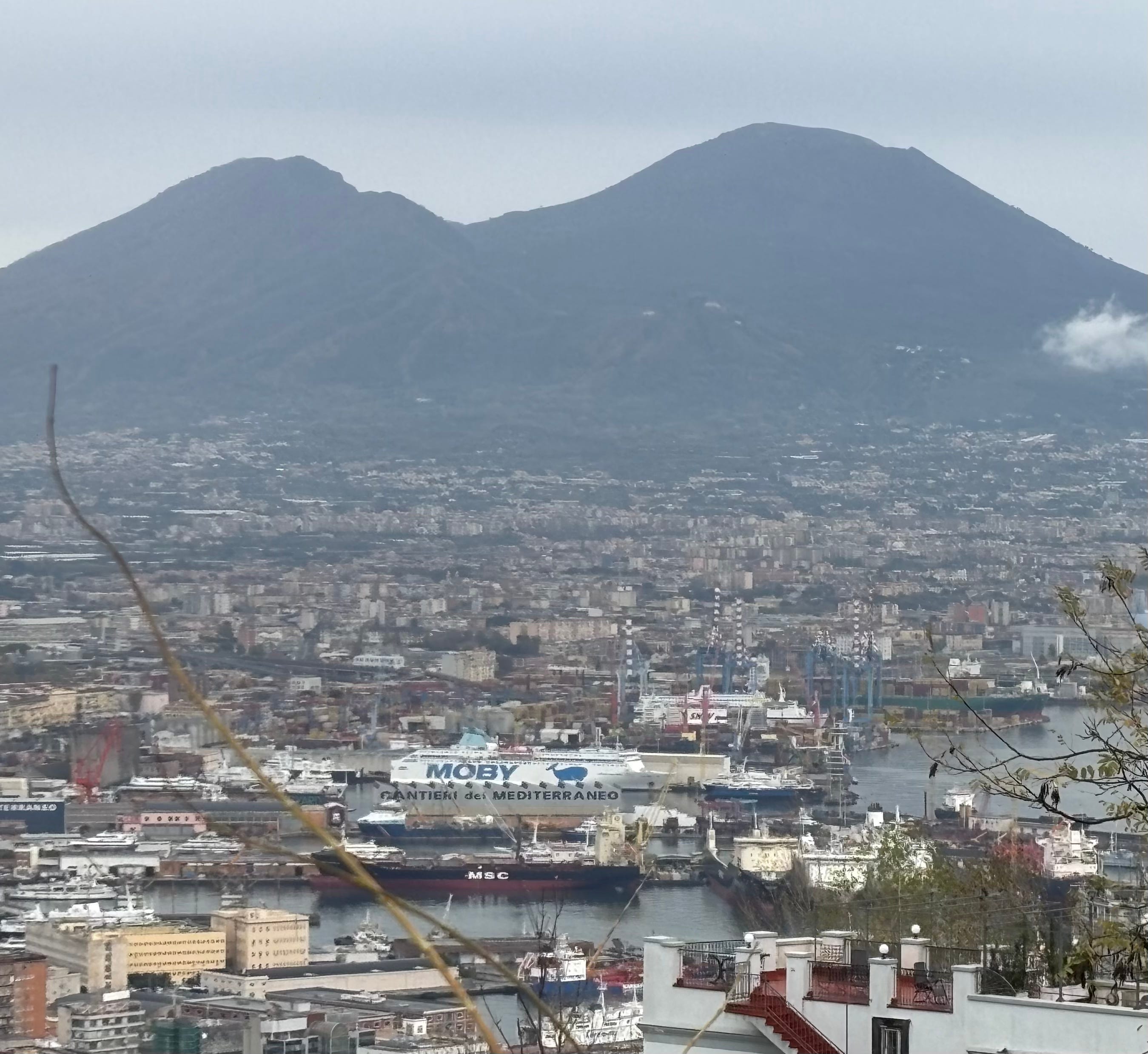
I had dinner with a couple who live in a town nestled against the volcano, in the highest threat zone. The husband quoted a French sociologist whose name he couldn’t call up who said that Naples is the most beautiful city in the world, if you can live aesthetically (I think he mentioned this in response to my misadventure with the closed Metro). I am not made for living aesthetically. Not for long, anyway. And even if I were, I was on a schedule and a budget.
But I did make it to some of the many churches in the historic center. Six, I think. I said my morning prayers at the Gesù Nuovo, the city’s famous Jesuit church, to the soundtrack of the Taïzé chant “Jesus, Remember Me” in English and a solid-looking fellow in a track suit announcing the next mass and hassling the male tourists to take off their hats. There’s a career goal: become that guy. The old romantic error repeating itself. I was picked off as an easy mark by a shoeless woman at the shrine of St. Giuseppe Moscati. I gave her $20, not having any Euros. The shoes she needed would cost a hundred, she told me in French. I wished her bonne chance.
At Santa Chiara, next to the Gesù, I happened upon some kind of service peopled by the provincial police in full dress—capes, hats, swords, it was fantastic. National stereotypes are on full display with police forces. American cops look like they’re ready to patrol Fallujah; Italian cops look like they’re ready for a parade to break out. I left with the current of sharply-dressed civil guards, which promptly collided with an opposite wave of school kids. A rather shabby Father Christmas stood hawking something at the confluence. I saw him hours later, a few streets away, smoking a cigarette as he rang his bell.
My new Neapolitan connections had slightly disparaged the city’s cathedral, but my curiosity couldn’t be deterred. There was a big crowd in the remarkably high-domed side chapel dedicated to the blood of San Gennaro, which liquefies on three occasions each year, though I wasn’t clear if there was a specific reason for this particular gathering. The billowing frescoes and bulbous ornamentations impress me more than they move me. And tourist that I am, I resent the presence of other tourists. Or at least I find the ratio of tourists to worshipers, kids at a tutoring program (as I thought I glimpsed through a door at San Giorgio), or just people sitting down somewhere for free to be instructive. I’m not Catholic, but I genuflect when I get into the pews and reverence the side chapel altars and I say my prayers. I put some money in one till or other, whether for the ministry of the parish or the Sisyphean task of maintaining these testaments to infinite headroom I don’t inquire or particularly care. If I can’t be the guy who hassles the visitors about their hats, I can at least drop some money without asking any questions.
But I’m glad I took the advice of the Neapolitans to see San Lorenzo. I had to squeeze it in on my last morning as I rattled my roller bag along the wet cobblestones toward the train station. In fact I got there before opening hours started, though perhaps after the weekday morning Mass. Anyway it was dark, and apart from two people at a desk of unknown purpose and some others moving around the chancel, it was empty. After the rococo excesses of the Cathedral and the Gesù, San Lorenzo’s Gothic austerity hit me like, well, a ton of bricks.
I said my morning prayers as respectfully and unobtrusively as I could in the cold, dark silence. Then, since a few curious visitors had started trickling in to explore the space, I had a look at the side chapels. One had been given over to a classic Neapolitan creche scene2, with a smiling drunk passed out in the foreground, a beshawled strega supervising a cooking fire and a plate of fish to the left, and Mary and Joseph, warmly lit, hovering over an empty manger to the right. In another chapel, there was nothing but an electric light box that intermittently revealed something—Saint Michael battling the serpent?—as it blinked on and off. The altar was flanked by two seasonal installations, both a bit tacky and incongruous in their serene surroundings.
I loved it. Not ironically, not as a tourist, not even as a supercilious Protestant confirmed in his aesthetic stereotypes, but deeply and sincerely did I love these awkward adornments. They bore witness to something more important than the wealth of ages past, the labor of artisans known and forgotten, the grandeur of an imagined, lost cultural coherence. They proclaimed that this place was still someone’s home, that the sounds and gazes which traveled up the sheer, barren walls were looking for God, not a transient experience of commodified awe. That’s as much beauty as any space can bear.
NB: My travel to Naples was generously supported by the church I serve as part of my sabbatical.
New Writing: Mainline Revival?
My first offering as a regular columnist at The Christian Century, from the January issue, is online now. It’s about whether a revival of American Christianity is in fact happening and, if so, whether mainline Protestantism can share in it:
If this drift is in fact happening, I don’t find it hard to see why. Maybe the story of inexorable secularization was always oversold. Just because people dropped the habit of going to a place each week to engage in prescribed rituals doesn’t mean they’d lose a taste for mythical narratives or nonmaterial phenomena. Declining church participation hasn’t made us any less likely to see demons in our vaccines or original sin in the events of our history. The master narratives of our supposedly secular age might be exhausting themselves. The development of human knowledge in fascinating new directions hasn’t banished mystery from the world. Humanity is still nature’s problem child, and nature herself seems to be pretty weird. Why should a religious revival be impossible?
It may be that such a revival is a statistical blip, the apprehension of vibes, a grasping for narrative where there is only noise. Or it may be just a pause in a long-term trend of decline.
But if revival is possible, let alone underway, it confronts mainline Christians with the limits of our own understanding of secularization. We have been identified so closely with decline for so long that it has become a weight-bearing part of our self-image.
One possibility that occurred to me as I wrote this is that the harshly critical stance of mainline institutions toward Christianity as such may itself be a response to decline—an effect that we project backwards as a cause. Read the whole thing (and subscribe).
Also I was a guest on the Church and Main podcast hosted by Dennis Sanders, talking about my article on liturgy and partisan polarization in the Journal of Lutheran Ethics. Dennis pulled my aphorism—don’t let the Devil set the agenda—for the title and I’ve found it to be a pretty helpful guideline for myself. Give it a listen if you’re curious. My hemming and hawing thins out after the first few minutes (somehow I react to every biographical question as if it were a total surprise).
If you go to Naples and like museums, catacombs, and the like, I strongly recommend the Artecard, which provides three free entrances and discounts on subsequent entrance fees. I used it five times in two days (and only missed using it a sixth time because a museum that Google Maps said was open was actually closed).
I saw so many creches. These people go nuts for a creche. There were dozens at the San Martino cloister alone.
Great first column! “Almost “ makes me wish I had not retired. (Almost.). I resonate with your perspective, and shudder at the idea that a Christian minister told this guy that Jesus didn’t exist. Makes me want to put my head on the table. And I even read your article in Lutheran Ethics. Polarization is part of why I retired. Long story though.